
Emergency Storm Board-Up & Weather Seal
Stop the Damage Tonight, Fix It Right After.
Learn moreTwo of the most common after-hours chimney calls — a damper rusted shut and the smell of gas near a fireplace — both deserve a fast, competent response rather than forcing it or waiting and worrying. For a gas smell we shut the valve and leak-test with a manometer drop and bubble-soap check; we don't put gas back in service unverified. A seized damper we free properly with penetrating oil and technique — forcing it snaps the control — then address the water source that rusted it.
Two of the most common after-hours chimney calls are a damper rusted shut (or stuck open) and the smell of gas near a fireplace or log set — and both deserve a fast, competent response rather than a homeowner forcing it or waiting and worrying. A jammed damper can trap smoke or bleed your heat; a gas smell is a potential leak that needs to be shut off and verified now. Prime Chimney Experts responds to both quickly, resolves the immediate hazard safely, and fixes the underlying cause so it doesn't recur.
A gas smell at a fireplace is the call to take most seriously, and our response is built around safety first. We dispatch to shut off the gas valve serving the fireplace or log set and then leak-test the system to find whether there's an actual leak and where — a manometer drop test and bubble-soap check of the supply, shutoff, and connections. We don't reassure you that 'it's probably fine'; we verify the system is tight before it's put back in service, or we isolate and repair the leak. If you smell gas, leave the area and call us — and the utility — immediately.
A stuck damper is less dangerous but genuinely disruptive, and forcing it makes it worse. A damper rusted shut means you can't safely use the fireplace — light a fire under a closed damper and smoke fills the room; a damper jammed open bleeds conditioned air continuously. Homeowners who crank on a seized damper usually snap the control or break the plate, turning a freeing job into a replacement. We free a rusted or jammed damper properly — penetrating oil, mechanical working, and the right technique — so it operates again, and where it's too far gone, we replace it.
Both problems are usually symptoms worth addressing at the cause. A damper that rusted shut points to water getting into the chimney — a cap, crown, or flashing issue letting moisture corrode the metal — and freeing the damper without addressing the water just sets up a repeat. A gas smell may trace to a worn connection, a failing valve, or a log set that needs service. We tell you what actually caused the emergency and what makes it permanent, and we document the gas leak-test result and the damper work for your records and any related claim or appliance warranty.
At Prime Chimney Experts, a stuck-damper & gas-smell emergency response is never guesswork. We scope every job from a graded, photographed inspection first — the NFPA 211 level the evidence calls for — so the work is matched to what your flue and masonry actually need, with the report to prove it. The documented inspection is the record the stuck-damper & gas-smell emergency response is built on.
Chimney inspectionA stuck-damper & gas-smell emergency response isn't a matter of opinion — it's held to published national standards. Prime Chimney builds every job to the named codes below and documents it, so the work is provably right for an inspector, an insurer, or a future buyer. These are the universal standards; your city's permit and inspection requirements are confirmed with the local authority before we pull the job.
A gas system is leak-tested with a manometer drop test and bubble-soap check and confirmed tight — or isolated and repaired — before it is put back in service; 'probably fine' is not a standard applied to gas.
Codes cited are the established national standards (NFPA, UL, IRC) that govern this service. The adopted code edition, permit, and inspection requirements vary by city —Prime Chimney verifies them with your local authority having jurisdiction on every job.
For a gas smell, shut off the valve serving the fireplace; for a damper, stop any attempt to force it.
Run a manometer drop test and bubble-soap check of the supply, shutoff, and connections.
Free the rusted damper with penetrating oil and technique (or replace it); isolate and repair any gas leak.
Address the water source behind a rusted damper or the worn connection behind a gas smell; document the work.
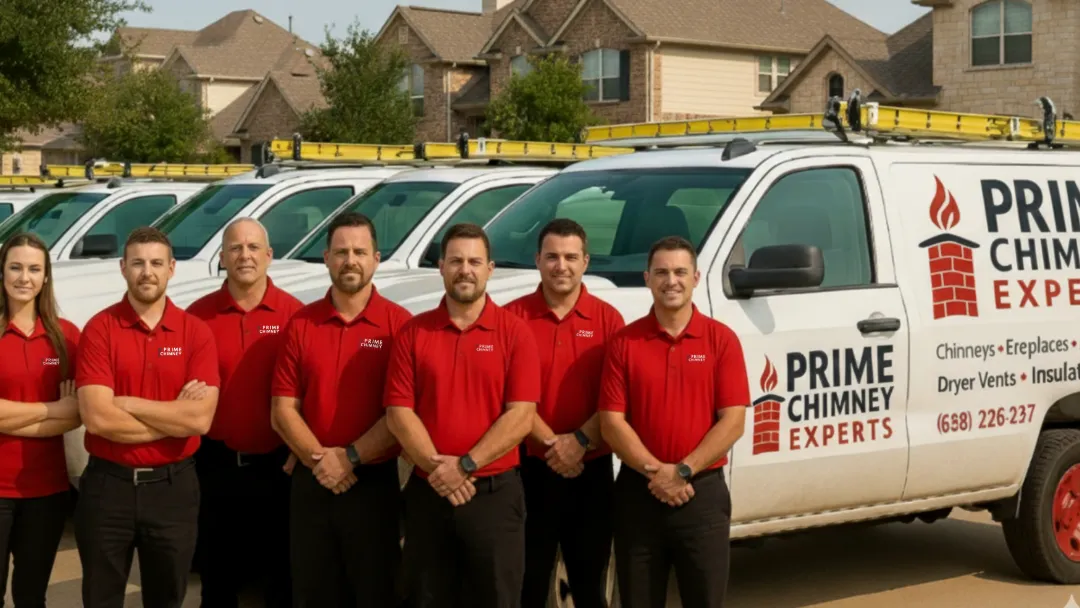
We've worked on 1,000+ DFW homes over 10+ years. Every job — small sweep or full rebuild — runs the same way: certified technicians, written quotes, photo reports, warranty in writing.
Gas smell taken seriously — valve shut off and the system measured, not assumed
Manometer drop test + bubble-soap check before gas goes back in service
Rusted/jammed damper freed properly with penetrating oil and technique, not forced
Underlying cause fixed — the water source behind rust, the worn gas connection
Family-owned, CSIA-certified, NFPA 211–compliant. We're the team you call when you want it done right the first time — no rotating subcontractors, no upsell pressure, no surprises. Same techs, same trucks, same standard.
Representative comments from homeowners we've served. We don't compose them — and we don't hide negative feedback, we fix it.
"Showed up on time, gave a clear inspection report with photos, and fixed our cap same-day. No upsell pressure."
 Sara L.Plano, TX · Chimney Cap Installation
"Best chimney service in the area. Written quote before work, no surprises, professional from start to finish."
 Robert G.Frisco, TX · Crown Repair
"Honest, professional, and reasonably priced. Highly recommended for anyone needing chimney work."
 David R.Dallas, TX · Chimney Sweep
"Replaced our cracked crown — they explained everything, sent insurance docs, and it's held up through 3 winters now."
 Jessica M.McKinney, TX · Chimney Crown
"Did the relining job on a 1970s house. Code-compliant, NFI specialist signed off. Worth every penny."
 Michael T.Irving, TX · Chimney Liner
The NFPA recommends an annual chimney inspection (Level 1), with sweeping done when buildup reaches 1/8" of creosote. For active wood-burning fireplaces, that's typically once per heating season.
Our chimney inspectors hold current CSIA (Chimney Safety Institute of America) certifications, verifiable via the CSIA member directory at csia.org. We also have NFI specialists for fireplace installations.
Yes — emergency response is available 24/7 (subject to crew availability) for active water leaks, animal trapped in flue, post-fire damage, and storm damage. Same-day in most cases.
Always. We provide a written quote before any work begins, with photos of the issues we found. Final pricing depends on chimney condition and any additional work identified during inspection.
Prime Program is our annual maintenance program at $19.99/month ($240/year). Includes: annual Level 1 inspection and sweep ($248 value), priority scheduling, 10% off all repairs, and emergency response priority. Cancel anytime, no contract.
Last reviewed:
Other services in the Emergency / 24-7 category.
Free written quote. Same-week scheduling. 24/7 emergency response when you need it.
Active leak, animal in flue, post-fire damage, or smoke event? Real humans on the line 7 AM to 12 AM every day — replies in under 2 minutes. Tech dispatch within 2 hours during business hours, subject to crew availability after-hours.
Emergency line