Chimney Asbestos & Lead Abatement
Contained, Licensed, Clearance-Tested.
Learn moreA carbon monoxide problem is the one chimney hazard you can't see, smell, or afford to guess about. We diagnose CO and combustion-spillage with instruments — a combustion analyzer reading CO/O2/stack temp, a draft gauge, and a worst-case depressurization test that catches the spillage a calm-day check misses — correct the actual source, then re-measure to verify the fix. An unverified CO fix is just hope.
A carbon monoxide problem is the one chimney hazard you can't see, smell, or afford to guess about. When a CO detector alarms, when a flame burns wrong, or when a tight home starves an appliance of air, the difference between a real fix and a dangerous reassurance is whether someone measured it. Prime Chimney Experts diagnoses CO and combustion-spillage problems with instruments — combustion analyzers, draft gauges, and worst-case depressurization testing — and corrects the source, then verifies the fix by re-reading the numbers.
CO comes from incomplete combustion and from flue gases spilling into the house instead of going up the chimney, and finding the cause takes measurement, not intuition. We probe the appliance with a combustion analyzer to read CO, O2, and stack temperature, measure draft in inches of water column at the draft hood, and run a worst-case depressurization (BPI-style) test — closing doors and running exhaust fans to put the house at its most negative — to see whether the flue still drafts or spills under real-world conditions. A tight, exhaust-heavy modern home can pull combustion gases back down a chimney that tests fine on a calm day; only worst-case testing catches it.
Once we know the mechanism, we correct it at the source. If the appliance is mis-tuned, we tune the burner into spec. If the flue is spilling because of a draft problem, we fix the draft — resizing, a draft-inducer, or a height correction. If the house is depressurizing the combustion zone, we add combustion air or seal return leaks. If an oversized common flue is orphaning a lone water heater after a furnace upgrade, we re-line it to the correct size. The fix matches the actual finding — not a parts-swap guess.
The non-negotiable final step is re-verification. After the correction, we re-run the combustion and draft readings and re-test under worst-case conditions to confirm CO is in spec and the flue draws without spilling, and we document the before-and-after numbers. We also address detection: standard UL-2034 alarms only sound at 70 ppm and ignore the chronic 5–30 ppm exposure that causes long-term harm, so where appropriate we place low-level (7-ppm) monitors near combustion appliances and sleeping areas and can wire a spillage interlock that shuts an appliance down on backdraft.
At Prime Chimney Experts, a carbon monoxide diagnosis & combustion safety is never guesswork. We scope every job from a graded, photographed inspection first — the NFPA 211 level the evidence calls for — so the work is matched to what your flue and masonry actually need, with the report to prove it. The documented inspection is the record the carbon monoxide diagnosis & combustion safety is built on.
Chimney inspectionA carbon monoxide diagnosis & combustion safety isn't a matter of opinion — it's held to published national standards. Prime Chimney builds every job to the named codes below and documents it, so the work is provably right for an inspector, an insurer, or a future buyer. These are the universal standards; your city's permit and inspection requirements are confirmed with the local authority before we pull the job.
Spillage is confirmed by putting the house into worst-case depressurization — doors closed, all exhaust running — and measuring whether the combustion appliance zone still drafts, per BPI combustion-safety practice.
After the source is corrected, combustion and draft readings and the worst-case test are re-run to confirm CO is in spec and the flue draws without spilling; the before/after numbers are documented.
Standard UL-2034 alarms only sound at 70 ppm; low-level (≈7-ppm) monitors are placed near appliances and sleeping areas to catch the chronic exposure those alarms ignore.
Codes cited are the established national standards (NFPA, UL, IRC) that govern this service. The adopted code edition, permit, and inspection requirements vary by city —Prime Chimney verifies them with your local authority having jurisdiction on every job.
Read CO, O2, and stack temp with a combustion analyzer; measure draft at the hood.
Run a worst-case depressurization test — doors closed, exhaust running — to reveal spillage.
Tune the burner, fix draft, add combustion air, or resize an orphaned flue per the finding.
Re-run readings and the worst-case test; document before/after; place low-level monitors/interlock if wanted.
We've worked on 1,000+ DFW homes over 10+ years. Every job — small sweep or full rebuild — runs the same way: certified technicians, written quotes, photo reports, warranty in writing.
Combustion analyzer reads CO, O2, and stack temp at the appliance — measured, not guessed
Worst-case (BPI-style) depressurization test catches intermittent spillage
Source correction matched to the finding, then re-verified with the numbers
Low-level (7-ppm) monitor placement and spillage-interlock wiring on offer
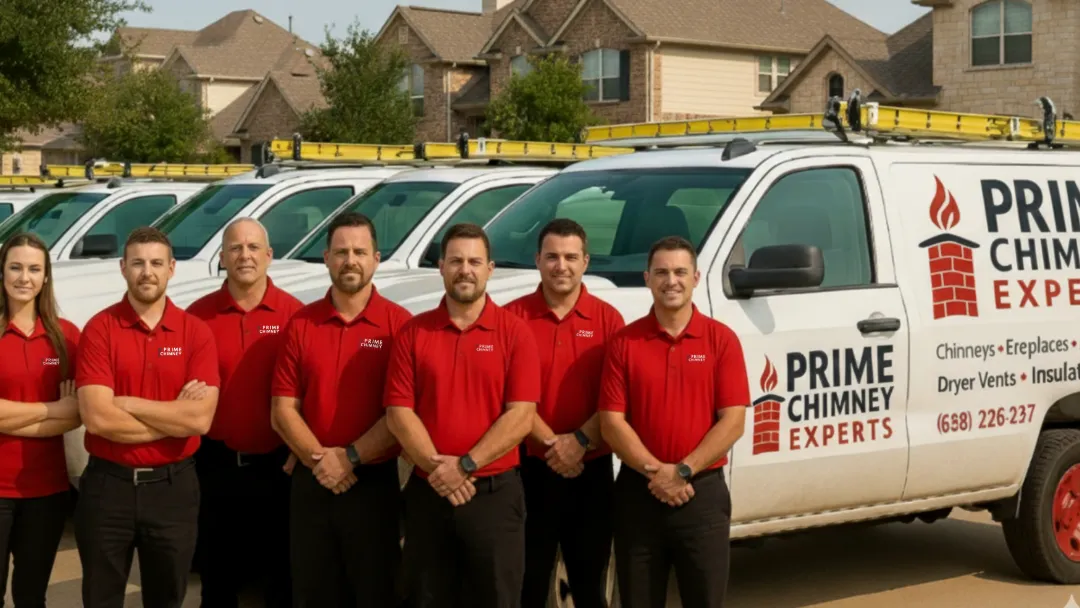
Family-owned, CSIA-certified, NFPA 211–compliant. We're the team you call when you want it done right the first time — no rotating subcontractors, no upsell pressure, no surprises. Same techs, same trucks, same standard.
Representative comments from homeowners we've served. We don't compose them — and we don't hide negative feedback, we fix it.
"Showed up on time, gave a clear inspection report with photos, and fixed our cap same-day. No upsell pressure."
 Sara L.Plano, TX · Chimney Cap Installation
"Best chimney service in the area. Written quote before work, no surprises, professional from start to finish."
 Robert G.Frisco, TX · Crown Repair
"Honest, professional, and reasonably priced. Highly recommended for anyone needing chimney work."
 David R.Dallas, TX · Chimney Sweep
"Replaced our cracked crown — they explained everything, sent insurance docs, and it's held up through 3 winters now."
 Jessica M.McKinney, TX · Chimney Crown
"Did the relining job on a 1970s house. Code-compliant, NFI specialist signed off. Worth every penny."
 Michael T.Irving, TX · Chimney Liner
The NFPA recommends an annual chimney inspection (Level 1), with sweeping done when buildup reaches 1/8" of creosote. For active wood-burning fireplaces, that's typically once per heating season.
Our chimney inspectors hold current CSIA (Chimney Safety Institute of America) certifications, verifiable via the CSIA member directory at csia.org. We also have NFI specialists for fireplace installations.
Yes — emergency response is available 24/7 (subject to crew availability) for active water leaks, animal trapped in flue, post-fire damage, and storm damage. Same-day in most cases.
Always. We provide a written quote before any work begins, with photos of the issues we found. Final pricing depends on chimney condition and any additional work identified during inspection.
Prime Program is our annual maintenance program at $19.99/month ($240/year). Includes: annual Level 1 inspection and sweep ($248 value), priority scheduling, 10% off all repairs, and emergency response priority. Cancel anytime, no contract.
Last reviewed:
Other services in the Remediation & Remodel category.
Free written quote. Same-week scheduling. 24/7 emergency response when you need it.
Active leak, animal in flue, post-fire damage, or smoke event? Real humans on the line 7 AM to 12 AM every day — replies in under 2 minutes. Tech dispatch within 2 hours during business hours, subject to crew availability after-hours.
Emergency line